Stop betting blind in the dark. The other IPO: Identifying Probable Outcomes.

--:--:--Sign in
// CONCEPTS · TRADER TERMS FOR LIVE BETTORS

Speak the language.

The same concepts that move money in equities and futures move money in live sports markets. Here's the translation, with examples from games you actually bet on.

[01] · ORIGIN: TRADING

Fair Value Gap (FVG)

Plain definition

A price imbalance left behind when the market moves so fast that a zone of orders is skipped. Traders watch for price to return and 'fill' it.

Translated for betting

When a live line moves violently after a single play (a dunk, a home run, an injury) the books often overshoot. The 'gap' between where the line is now and where the model says it should be is the FVG. Smart money fades the overreaction and waits for the line to come back.

Worked example

LAL is +2 live. Star wing hits a deep three to tie. Line snaps to LAL -1 in 4 seconds. Model only justifies LAL -0.5 — the half-point in between is the gap. Bet BOS +1 and wait for the line to drift back to pick.

How to spot it on EDGE.LIVE

Look for >1 full point of ML or spread movement on a single possession with no injury news. The Win Probability chart on the terminal will candle-spike, then fade — that fade is the gap closing.

[02] · ORIGIN: TRADING

DCA — Dollar Cost Average

Plain definition

Splitting a position into multiple smaller entries over time instead of betting full size at once. Reduces the cost of being early.

Translated for betting

Instead of slamming your full unit on LAL ML at -120, you bet 1/3 unit at -120, 1/3 at -110 if it drifts, and 1/3 at +100 if the game goes against you early. Your blended price is better than any single ticket and you survive bad variance.

Worked example

You like the under in a TB vs HOU game (total 8.5). 1/3 unit on Under 8.5 (-105) pre-game. After a 1st-inning run, total moves to 9. 1/3 on Under 9 (-110). Quiet 4th, total back to 8.5. 1/3 on Under 8.5 (-115). Average price: better than any single entry.

How to spot it on EDGE.LIVE

Use DCA when you have a strong directional read but volatile early innings/quarters are likely. The Practice Floor lets you place laddered tickets — try it there first.

[03] · ORIGIN: TRADING

State of Delivery (SOD)

Plain definition

The precise moment an asset is contractually 'delivered' — the point at which all uncertainty resolves and the position settles.

Translated for betting

The exact micro-event your bet hinges on. Not 'will LAL win' (broad) but 'will LAL be ahead at the end of Q3' (specific delivery point). Live betting is a chain of delivery moments — knowing which one your edge depends on is the difference between a calculated bet and a vibe bet.

Worked example

You bet LAL -3.5 live in Q3. The SOD isn't 'final score' — it's the buzzer. Every made basket between now and that buzzer either moves you toward delivery or away from it. Hedge windows open at every score; choosing not to hedge is itself a position on each remaining delivery moment.

How to spot it on EDGE.LIVE

On the terminal, the AI Advisor will tell you the SOD for your ticket if you ask 'what does this bet need to happen?'. Use that before you cash out early.

[04] · ORIGIN: BOTH

Edge

Plain definition

Your model's probability of winning minus the market's implied probability. Positive = the market is paying you more than the outcome is worth.

Translated for betting

If your model says LAL wins 55% of the time and the consensus ML of -110 implies 52.4%, your edge is +2.6%. Over hundreds of bets, that 2.6% is the entire game. Edge under 2% gets eaten by vig and variance — don't bet it.

Worked example

Best price on LAL ML is +105 across the books. Implied = 48.8%. Your model says 52%. Edge = +3.2%. That's a bet. Same model, same game, but the line is -130 (implied 56.5%) — edge is now -4.5%. Pass.

How to spot it on EDGE.LIVE

The terminal shows live edge in the signal grid. Green = positive edge. Red = the market is overpricing this side.

[05] · ORIGIN: BOTH

Implied Probability

Plain definition

The win probability baked into a price by the market, before vig adjustment.

Translated for betting

Convert American odds to a percentage. -150 means the market thinks this side wins ~60% of the time. Your only job as a bettor is to find spots where your honest probability is higher than the implied.

Worked example

+250 = 28.6% implied. -110 = 52.4% implied. -300 = 75.0% implied. Memorize the breakpoints at +100 (50%), -110 (52.4%), -150 (60%), -200 (66.7%) and you can price any market in your head.

How to spot it on EDGE.LIVE

Every odds display on EDGE.LIVE shows the implied % next to the price (e.g. '-94 · 48.5% implied'). No mental math required.

[06] · ORIGIN: BETTING

Vig (Juice)

Plain definition

The book's commission, baked into the odds. The reason a coin-flip market pays -110 / -110 instead of +100 / +100.

Translated for betting

If both sides of a market imply more than 100% combined, the overlap is the vig. Standard NBA/MLB ML markets carry 4-5% vig. Live markets often carry 8-12%. You need a bigger edge to beat live vig.

Worked example

Pre-game LAL/BOS: LAL -110 (52.4%), BOS -110 (52.4%). Sum = 104.8% — vig is 4.8%. Live in Q4 same game: LAL -125 (55.6%), BOS +105 (48.8%). Sum = 104.4%, but the bid/ask spread is wider — effective vig is closer to 8%.

How to spot it on EDGE.LIVE

The Line Shop on the terminal highlights the lowest-vig book per market. Always shop.

[07] · ORIGIN: TRADING

Liquidity

Plain definition

How much volume a market can absorb before the price moves against you.

Translated for betting

NBA/MLB sides on regulated US books have deep liquidity — you can usually get $1K down without moving the line. Live player props and obscure markets have thin liquidity — your bet itself moves the price. Bet small in thin markets.

Worked example

Pre-game LAL ML: a $5K bet barely budges the line. Live 4th-quarter LeBron over 27.5 points with 2 minutes left: a $200 bet moves the line by 5 points because nobody is on the other side.

How to spot it on EDGE.LIVE

The Public/Sharp split on the terminal hints at liquidity. When public % and sharp % both spike on the same side, the line is about to move — get in before it does.

[08] · ORIGIN: BETTING

Reverse Line Movement (RLM)

Plain definition

The line moves the OPPOSITE direction of the public's bets. A classic sharp-money signal.

Translated for betting

If 75% of public tickets are on LAL but the line drifts FROM LAL -3 TO LAL -2.5, it means the few sharp bets on BOS are bigger than all the small public LAL tickets combined. Follow the line, not the crowd.

Worked example

Public: 78% on Over 224.5. Line opens 224.5, drifts to 223.5 by tip-off. RLM signal — sharps are on the under. Likely play: under.

How to spot it on EDGE.LIVE

The terminal flags RLM under the Public/Sharp signal cell. When you see it, the AI advisor will tag the moving side as a probable sharp lean.

[09] · ORIGIN: BETTING

Closing Line Value (CLV)

Plain definition

Whether your bet's price was better than the final price the market closed at. The single best long-term predictor of profitability.

Translated for betting

If you bet LAL -2 (-110) and the line closes LAL -3 (-110), you got +1 point of CLV. Bettors who consistently beat the close win long-term, even if the individual bet loses.

Worked example

You take Under 8.5 (-105) at noon. By first pitch the total is Under 8 (-115). The market agrees with your direction — you 'beat the close' by 0.5 points and 10 cents of price. Even if the game goes over, you bet correctly.

How to spot it on EDGE.LIVE

Track CLV in your Practice Floor bet history. Long-term ROI > 0 almost always correlates with positive average CLV.

[10] · ORIGIN: BOTH

Hedging

Plain definition

Taking the opposite side of an open position to lock in some profit (or cap a loss) regardless of outcome.

Translated for betting

You took LAL +6 pre-game at +100. Now LAL is up 4 in Q4 and the live spread is BOS -1.5 (+105). Bet a fraction of your original stake on BOS -1.5 — you've now locked in a guaranteed profit and capped variance for the final 6 minutes.

Worked example

Original: $100 on LAL +6 at +100 (to win $100). Live hedge: $52 on BOS -1.5 at +105 (to win $54.60). Outcomes: LAL covers +6 → +$100 - $52 = +$48. BOS covers -1.5 → -$100 + $54.60 = -$45.40. Middle (LAL wins by 2-5) → +$100 + $54.60 = +$154.60.

How to spot it on EDGE.LIVE

The terminal's Hedge Calculator (coming soon) will compute the exact hedge stake for any open ticket. For now: hedge stake = (original_to_win) / (hedge_decimal_odds).

[11] · ORIGIN: TRADING

Change of Character (CHoCH)

Plain definition

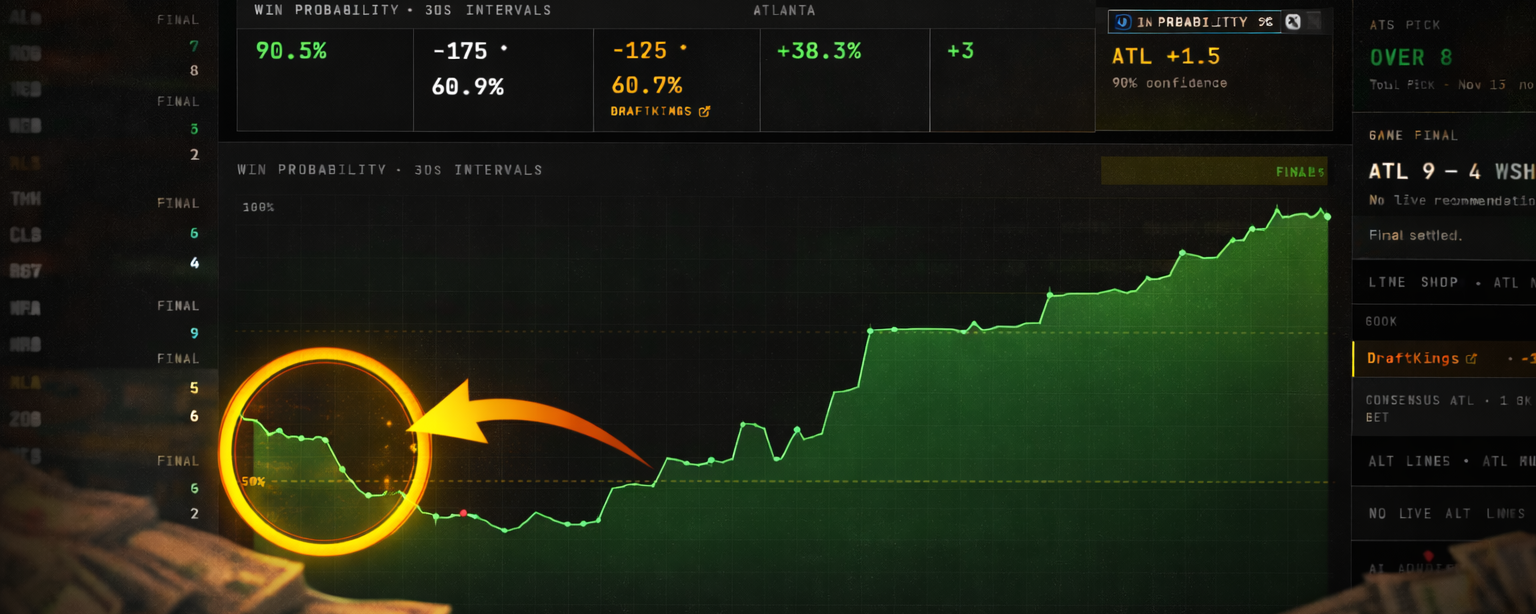
A market structure shift — the first higher-high after a downtrend, or first lower-low after an uptrend. Signals that the side in control has flipped before price fully reverses.

Translated for betting

The live win-probability or money-line trend breaks its prior pattern: the team that was bleeding probability all quarter prints its first meaningful higher-high, or the favorite that was grinding upward suddenly carves out a lower-low. The score may not reflect it yet, but the run, the pace, and the line are telling you control just changed hands. Bet the side that just took the structure.

Worked example

BOS has been climbing all of Q3, win prob 58 → 71%. Mid-Q4, LAL hits a 9-2 run; win prob ticks to 64% — first lower-low for BOS in 14 minutes. The spread quietly moves from BOS -4.5 to BOS -2.5. CHoCH confirmed. Live bet LAL +2.5 before the line catches up to the new regime.

How to spot it on EDGE.LIVE

Watch the Win Probability chart on the Live Terminal for a clean break of the prior swing low/high — the first candle that takes out the most recent pivot. Cross-check with momentum flipping sign and the Line Shop drifting against the previously dominant side. When all three align, that's CHoCH.

// PRACTICE WHAT YOU JUST LEARNED

Try these concepts on the floor — no real money.